
Why the Loop Matters: Process Variables Are Not Noise
Research Insight — 3D Concrete Printing
Based on the RILEM TC 304-ADC inter-laboratory study (ILS-mech) on the mechanical properties of 3D-printed concrete — Bos et al. (2024), open-access dataset. The 30 participating laboratories each printed and tested their own mix designs under a shared protocol. Charts generated by Sunnyday Technologies from the published dataset. See methodology note at bottom for analytical qualifications.
The Conventional Assumption
The conventional approach to 3D concrete printing treats the printing equipment as a neutral delivery mechanism — assume the printer does not matter, test the mix in isolation, report cube compressive strength at 28 days. That assumption is wrong, and a major international study has now quantified exactly how wrong.
The RILEM TC 304-ADC inter-laboratory study on 3D-printed concrete mechanics coordinated testing across multiple independent laboratories worldwide. In that study, each of the 30 participating laboratories developed and printed its own mix design on its own equipment, all tested under a shared protocol — the materials ranged across nine different commercial products and a range of self-prepared mixes. Because both the mixes and the equipment differ across labs, the dataset captures real material-and-process variation across the 3DCP research community — not measurement noise.
What the Data Shows
Across roughly 1,340 3D-printed specimens in the RILEM TC 304-ADC dataset — spanning early-age to mature tests — compressive strength ranges from 3.3 MPa to 130.2 MPa, a ~40× spread, with a standard deviation near 21 MPa. That range reflects the genuinely different mixes, equipment, and conditions across the 30 labs — not measurement error.
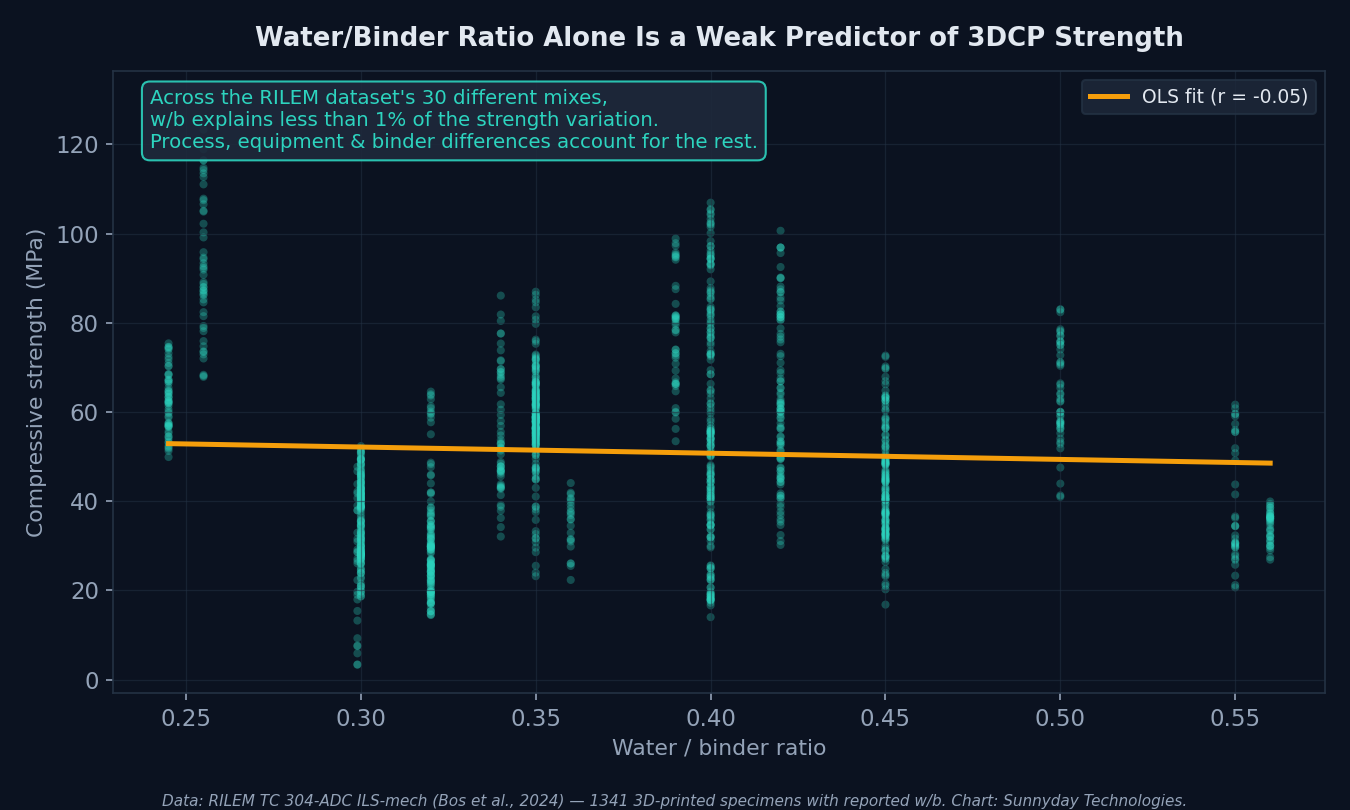
Water/binder ratio vs. compressive strength for the RILEM 3D-printed specimens. Across the study’s 30 different mixes, w/b alone explains less than 1% of the strength variation (r ≈ −0.05) — strength is governed by the binder system, equipment, and process, not by w/b alone. Data: RILEM TC 304-ADC ILS-mech (Bos et al., 2024).
What the Variance Actually Comprises
The RILEM ILS dataset is more carefully structured than most multi-lab studies. Alongside the mechanical results, it tracks a range of variables that legitimately explain a significant portion of the observed variance: loading direction (X, Y, Z, and cast reference), curing conditions, extraction location within the printed element, and specimen scale. These are not noise — they are real physical effects that the study was designed to quantify.
Orientation is a real and measurable effect: printed specimens underperformed cast references in this study, while the weakest printed direction varied by laboratory. Flexural and tensile results show a stronger penalty when tensile stress crosses a layer interface. Curing regime affects hydration state at test. Scale effects are well-established in concrete testing. When these variables are controlled or accounted for, within-condition variance is meaningfully reduced.
But here is the key finding: even after accounting for direction, curing, extraction location, and scale, substantial inter-laboratory residual variance remains. That residual is not explained by the tracked test variables. It reflects the different binder systems each laboratory used, together with equipment, process parameters, and material–process interactions that were not fully captured.
The Water/Binder Predictor in Context
The water/binder ratio has been the dominant predictor of concrete compressive strength for over a century. Abrams’ Law works reliably for cast concrete because the production process is standardized — vibration, formwork, curing conditions. In additive manufacturing, process is not standardized: it varies between every lab, every printer, and every print session.
The chart above plots w/b ratio against compressive strength for the RILEM printed specimens. The classic inverse relationship all but disappears once you pool the study’s 30 different mixes: across the pooled dataset, water/binder ratio alone explains less than 1% of the strength variation (r ≈ −0.05). The strength of any given specimen is governed far more by which binder system that lab used, and how it was printed, than by its water/binder ratio. The remaining variation is shared between the known test variables — loading direction, curing, scale, extraction location — and the untracked equipment and process variables. The known variables are large; the untracked process residual is meaningful and, critically, systematic.
The Implication for Machine Learning
This finding has a direct and underappreciated implication for any ML model trained on 3DCP data. The distinction matters: tracked variables are features; untracked variables are confounders.
Loading direction, curing regime, specimen geometry, and extraction location are legitimate model inputs. A well-structured 3DCP dataset that captures these variables gives a model real signal to learn from. The RILEM dataset demonstrates this clearly — these are variables worth encoding.
The problem is different: it is the equipment and process variables that are not tracked — print speed, layer height, nozzle geometry, open time management, pumping configuration — that become hidden confounders. When a model is trained on aggregated results from many labs without these variables recorded, it cannot distinguish material response from equipment response. It learns a relationship that is partly composition, partly process artifact, with no way to separate them at inference time.
The design implication is to record process variables as model inputs rather than leave them as hidden confounders. The RILEM dataset’s tracked variables — direction, curing, and scale — illustrate why that context matters. A proposed Sunnyday workflow is designed around the same principle; this article does not establish that such a closed loop is operating today.
What This Means for Sunnyday Technologies
The RILEM data makes a precise case: formulation alone is only a weak predictor when diverse mixes are pooled. A large portion of the remaining variance is attributable to known, trackable test variables — direction, curing, scale, location. A meaningful residual is driven by equipment and process parameters that literature datasets do not capture. That residual supports a design requirement: material, equipment, process, environment, and test context should be retained together.
Sunnyday is developing tools around that evidence workflow. Candidate formulations, experimental hardware, schema records, and testing remain separate evidence sources until they are connected and validated for a defined use.
This article does not establish that a recurring closed-loop training program is operating today, nor does it validate a model for project use.
Chart methodology: roughly 1,340 3D-printed specimens from the RILEM TC 304-ADC ILS-mech dataset that report a water/binder ratio, across all test ages. The 30 participating labs each used their own mix design, so the dataset spans many different materials. The trendline is an ordinary least-squares fit across the pooled specimens; water/binder ratio explains less than 1% of the strength variation (r ≈ −0.05) once the diverse mixes are pooled.